Overview
Pages
DAQS.IO is a platform designed to streamline and enhance the quality assurance (QA) and quality control (QC) processes within construction projects, particularly in Building Information Modelling (BIM) environments. By integrating with tools like Revit, DAQS.IO enables automated checks and validations of models against predefined standards and protocols, such as the BIM Basics ILS method. This level of automation reduces the manual effort required for QA/QC, minimising human error and increasing accuracy. It also facilitates early detection of inconsistencies, omissions, or non-compliant elements, thus ensuring that models meet both project-specific and industry standards. For QA/QC professionals, DAQS.IO provides a robust framework to ensure that models are reliable, well-coordinated, and ready for downstream processes like construction, fabrication, and facility management. This ultimately leads to more efficient project delivery and enhanced overall quality control.
DAQS portal for QA/QC
The DAQS portal has three main dashboards:
| Company Dashboard | Project Dashboard | Model Dashboard | |
|---|---|---|---|
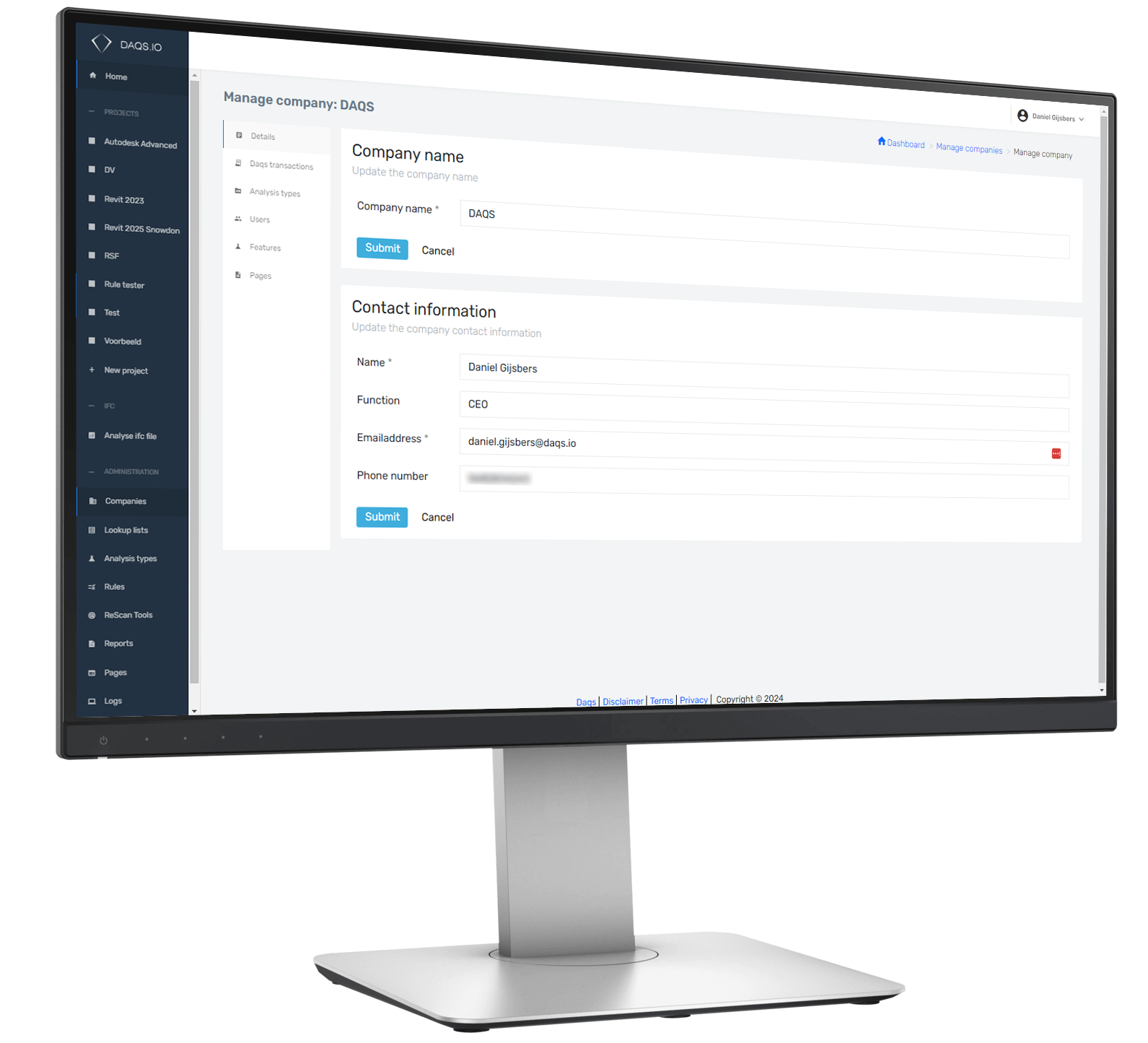 |
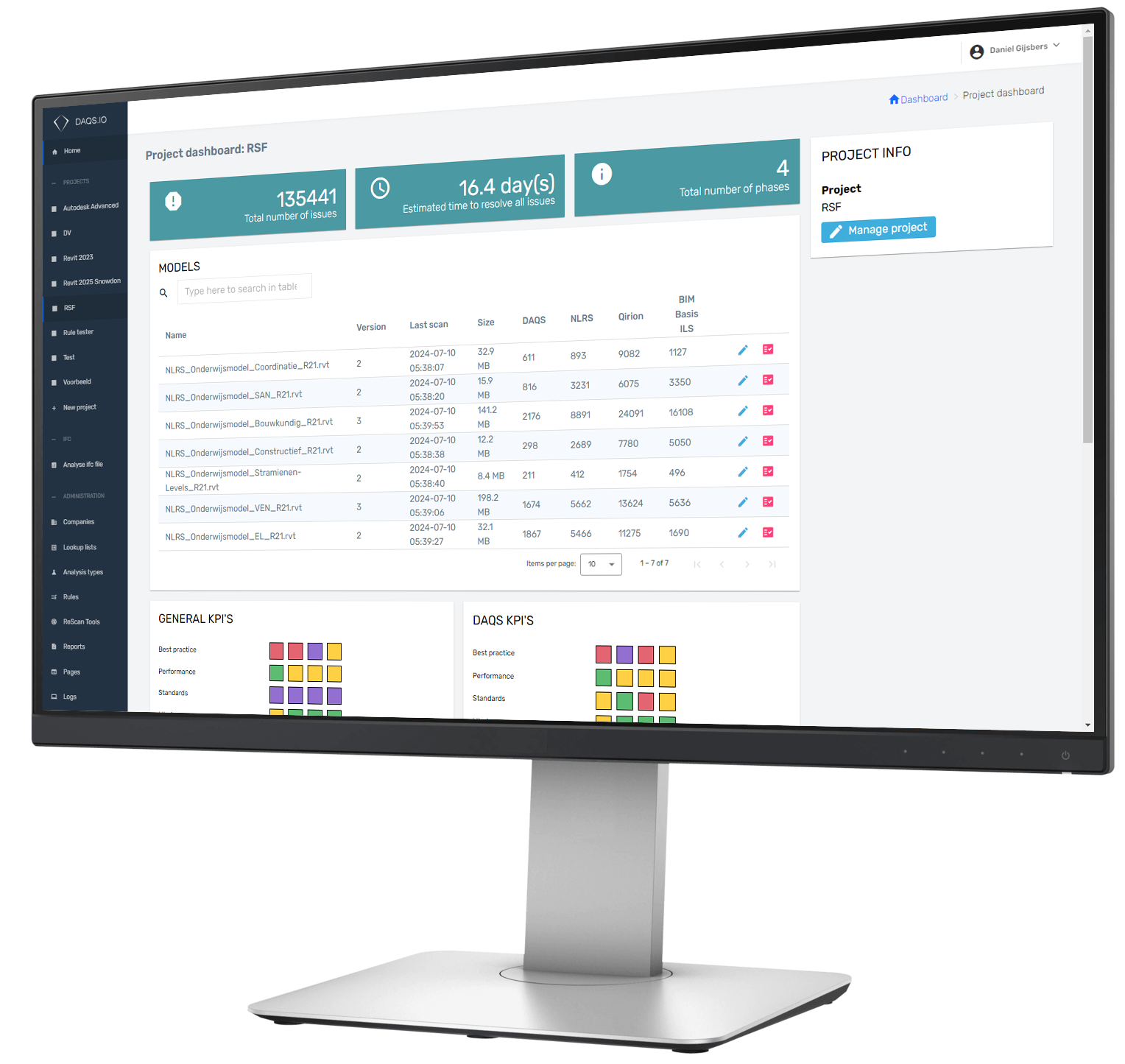 |
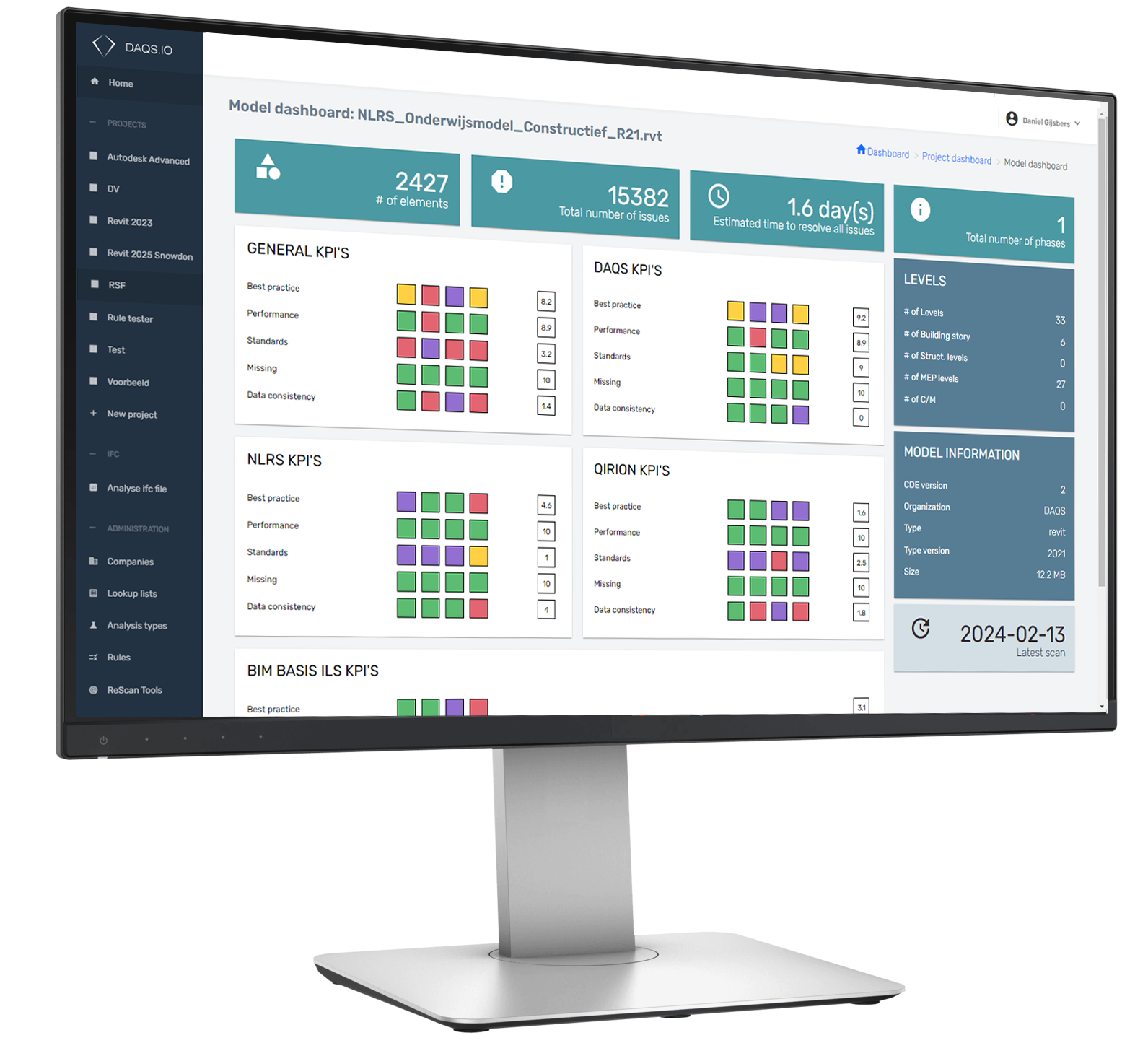 |
|
| Intended users | BIM manager | BIM coordinator | BIM engineers |
| Purpose | Project overview | Project status | Model status |
| Dashboard type | Company | Project | Model |
| Responsibility: | Multiple projects | A project | A model |
DAQS dashboard purposes
| Company Dashboard | Project Dashboard | Model Dashboard | |
|---|---|---|---|
| Role description: | A BIM (Building Information Modelling) Manager is a professional responsible for implementing and managing BIM processes and technologies within construction projects. They oversee the development, coordination, and maintenance of digital models that represent the physical and functional characteristics of a building or infrastructure. | A BIM (Building Information Modelling) Coordinator is a professional who facilitates the implementation and integration of BIM processes within a project, ensuring that the digital models are accurately developed and effectively used. | A BIM (Building Information Modelling) Engineer is a technical professional who specializes in using BIM technologies to create and manage detailed digital models of buildings and infrastructure projects. Their role involves both the technical development of BIM models and the application of engineering principles to ensure the accuracy and functionality of the designs. |
| Benefits: | - Insights into areas where costs can be saved and efficiency increased. - Reduced modelling time and costs. - Insights into the modelling process. - An overview of quality and progress across internal disciplines and third parties. - Project status and progress. - Development of BIM capabilities of employees. - Time savings compared to semi-manual IFC analyses. - Insights into the training needs of employees. |
- The ability to perform checks on source data. - Agreement with project partners on standardised checks before work begins. - Early identification of quality issues. - Insights into areas that need attention from project managers. - Insights into the quality of the data. - Possibility for data-driven decision-making. - Understanding where knowledge and skills can be further developed. |
- Time savings in the often time-consuming and tedious work of data validation. - Efficiency in ensuring consistency in models. - Personal insights for knowledge development and progress. - The ability to analyse a model during ongoing activities. |